Social Emotional
He is confident, he is kind and he is respectful.
He respects himself and others and plays with friends. He listens to directions and focuses on small projects for short periods of time. He is confident. He shares toys and how he feels.
Your Kindergartener
Your kindergartener doesn’t just sing along to R-E-S-P-E-C-T. He lives it. He believes in himself, approaching new tasks with confidence. He adapts to change. “We were going to grandma’s house, but we’ll meet her at the park instead.” “In five minutes, it’s time to turn off the TV and get ready for bed.” He manages transitions, too. While children are still learning to manage their emotions, your kindergartener is kind, he’s brave and he goes with the flow (more or less).
He also accepts guidance and follows instructions. He understands that as much as he knows, the adults in his life know more. He takes turns, sharing with other children and demonstrating patience even as he hands over his favorite toy.
-
I Can Label my Emotions
He doesn’t just cry (although he knows that crying is okay.) He expresses how he's feeling with words, too. He may not always have precise vocabulary for his feelings, but he can label simple emotions like sadness, anger and happiness. This key skill for social and emotional success later in life is in development. In response to his feelings, he is learning to ask for what he needs, too, identifying what would help him through in healthy ways.
Look for Signs of Learning at Your Child's Care
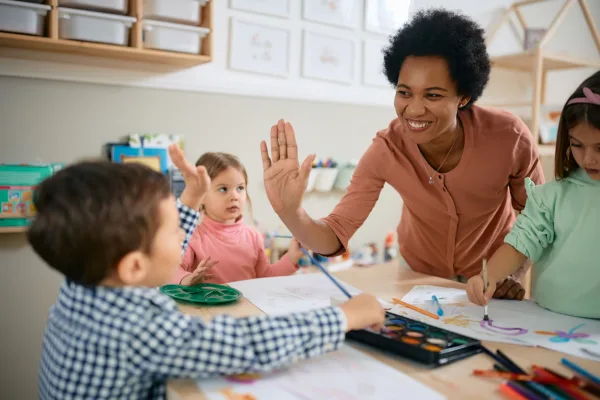
Does your child's provider create a safe environment for boys and girls alike to feel and express emotions? Does she nurture the children in her care even (especially) when they have big feelings? “It’s okay to be sad, Jamal. Do you want to take a few minutes in the quiet corner?” A quality program supports and helps children name their emotions.
-
I Can Focus...for a While!
“Watch what I can do!” takes on a whole new meaning when your kindergartener can focus on a task for 10 to 15 minutes. She might build a whole castle with blocks, read a short book from start to finish, mix cookie dough completely or put together a whole 12-piece puzzle. She can stay on task longer than ever before.
Look for Signs of Learning at Your Child's Care
Does your child’s provider offer opportunities to increase attention and time dedicated to a task? Does she recognize the amount of focus that is appropriate for your child’s development? Look for programs that encourage concentration for 10-15 minutes at this stage of your child’s life.
-
I Play with my Friends!
Remember when she used to play on her own? Or next to a friend? She still can, but now she can also play collaboratively with her peers. Together, they work toward common goals: building pillow forts, drawing chalk forests or solving riddles.
Look for Signs of Learning at Your Child's Care
Does your child’s provider offer opportunities for children to play collaboratively? “Nyquasha, do you want to build the bridge with Jessica?” Watch for games and activities that encourage children to work together.
Ideas to Learn and Play Together!
From play time to bedtime, your child is always learning. Check out these family-time ideas for building their skills, and your family connections. All children learn and grow at their own pace and in their own way. For more information about the skills and milestones for your child's age, check out our developmental milestones resource page.
-
Encourage Kindness
Model and talk your child through positive behaviors. And when he does something wonderful, let him know. When we praise children for the good things they do, they do good things more often. Be specific in your praise so that your child knows what he did well. “Great job helping your neighbor get up after falling off his bike! That was a nice thing to do.” Encourage kind choices consistently, and your child will better understand how to choose kindness.
-
When I Understand, I am Less Afraid
Even confident children get scared sometimes. That’s okay! So do adults! Help your child understand that her fear is normal and investigate why she is afraid. When we understand our fear, we are less afraid. “Is that a spider? Spiders look scary, but they actually do important work in nature. He probably got lost. Let’s take him outside together.”
-
Apologize and Grow
Like all humans, your child will make mistakes. When your child has hurt a friend, help him apologize and ask how he can help. Saying sorry and helping to fix the problem is an important skill to learn. Model the behavior for your child, and praise him when he has taken ownership and solved a problem. “I’m sorry I spilled your cheese crackers. That wasn’t nice. Can I help you clean them up?” Support your child in knowing that he isn’t bad, he just made a poor choice and he can fix it and do better next time.